crypt-orchid.blogspot.com
Today marks David Letterman’s 30th anniversary on late night TV.
Appropriately enough, his principal guest last night was Bill Murray, the first guest on both his NBC (1982) and CBS (1993) premieres.
When the NBC Late Night with David Letterman began, it was a breath of fresh air. It was knowing, it was snide, it respected its audience’s intelligence and its love of the bizarre.
The premiere opened with Calvert DeForrest (descendent of radio pioneer Lee DeForrest) reciting a “be very afraid” spiel in front of the Rainbow Room peacock dancers (yes, female “peacocks,” an actual attraction at the rooftop lounge in the RCA (now GE) Building).
Then came the first mini monologue and the first studio comedy bit (a backstage tour). The Murray segment ended with him and the host suddenly leaving the stage, and the screen switching to old film of the 1973 World Series.
That first episode ended with a comedian reciting the opening scene from an obscure Bela Lugosi movie. By the time I saw that bit, I knew I’d be a fan for life.
•
Letterman, the self-spoofing, genre-busting insurgent, is now the establishment, and has been for some time.
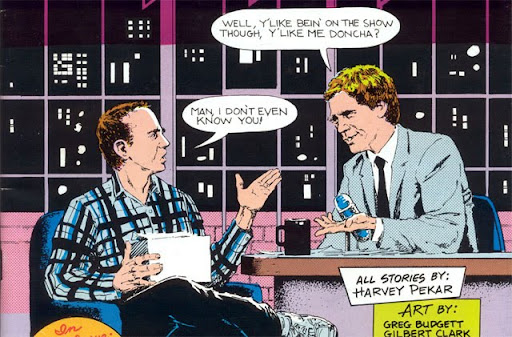
A persona that was once hip-to-be-square is now the grand old curmuddgeon. In this respect, he has become more like his onetime occasional foil Harvey Pekar (as seen above).
A collection of shticks that playfully (or awkwardly) toyed with the established celebrity-talk format has become a well-tuned programming machine, that regularly disseminates well-scrubbed guests plugging their films/shows/CDs.
Little comedy bits that had been cute and playful are now trotted out with slick animated openings and pompous fanfares. More of them these days are pre-taped or assembled from news footage, instead of acted out on stage.
The biggest flaw in Letterman’s current formula is the 12:15 a.m. commercial break, following the first guest spot. It runs between five and eight minutes, stopping the whole proceedings. It essentially begs viewers to shut ‘er down and hit the hay.
Still, there are worse fates to befall a creative performer than to become the sort of bigtime mainstream institution he had once scoffed.
Letterman could have grown old much less gracefully.
Like Leno.
•
PS: Here are some Letterman guest spots that one entertainment site considers classics. At least one actually is an all-time moment—a totally laugh-free, in-character Andy Kaufman spot from Letterman’s 1980 morning show.
PPS: Letterman began his career on Indianapolis TV in the early 1970s. The ill-fated, Seattle-born actress Frances Farmer ended her career in the same place and time. If I ever meet him, I’ll ask if he’d ever met her.


